Reflections, silences, and temptations beneath the glass. The shadow of desires, the art beneath the alarms, stolen reflections, and refined fusions. “Sophistication meets chaos, desire meets crime.” Echoes of the world unveil the heist of the century. Filled with secrecy and the irresistible curiosity of danger and risk. Not just stolen jewels, but stolen symbolism and signature jewels that marked Paris and French history.
This infamous jewelry heist took place in the early morning of October 19, 2025, at approximately 9:30 a.m. In broad daylight, four men dressed as maintenance workers, and in eight minutes, stole irreplaceable jewels that left the public heartbroken.
The thieves arrived, progressing onto a truck-mounted ladder to ascend towards the Gallerie d’Apollon (Gallery of Apollo), near the River Seine. Getting inside the Louvre and working their way in, the thieves used a power tool by cutting through the window with an angle grinder. The robbers’ threatening tactics forced the guards to evacuate the premises, as it could have been a security issue for their safety and the visitors’ safety.
According to French media, a preliminary report has revealed that one of the three raided rooms in the museum had no CCTV cameras. Along with the fact that the only camera outside the Apollo Gallery was facing the wrong way, and didn’t take video of the van arriving. At approximately 9:37 a.m., the men burst inside, and the museum alarm sounded and alerted the museum staff. Law enforcement was contacted, but it was already too late. Furthermore, at approximately 9:38 a.m., the thieves boarded onto a vehicle-mounted, extendable mechanical ladder, and then ran onto their scooters while fleeing southeast towards the A6 highway. And one by one, they vanished into the veins of Paris, untraceable and unreachable as a whispered lie. They were gone before the city even realized the jewels of history and purity had been touched.
What does the world preserve, and why do people preserve certain items? As a broader human flaw. To further grasp what the world owes to a person. “An appetite so deep it dared to lay hands on history itself.” Jewels that only reflect a hunger that could never be fed, or even more, destroy what others cherish and admire most.
A tiara and brooch belonging to Empress Eugénie, wife of Napoleon III. An emerald necklace and a pair of emerald earrings from Empress Marie-Louise. A tiara, necklace and single earring from the sapphire set that belonged to Queen Marie-Amélie and Queen Hortense. A brooch known as the “reliquary brooch.” Were all the purest beauties stolen from the Musée du Louvre? All belonged to French Royalty and Imperial Rulers. The found evidence included two angle grinders, a blow torch, gasoline, gloves, a walkie-talkie, a blanket, and a crown at the scene, which was possibly dropped as the robbers fled the museum.
Belonging to Empress Eugénie and adorned with over 1,000 diamonds, the crown was recovered on the street outside the premises but was repossessed and found damaged. The Louvre closed at once, but reopened that following Wednesday morning, October 22, 2025. This was a fragile decision, like placing an open lantern in a storm and hoping its flame would light.
Each jewel, each diamond, that vanished seemed to speak louder than silence, a silence of absence that not only reflected the museum’s halls, but the now-seen thresholds between creation, possession, and the “hunger that defies them.” The reflections between art, love, and theft.
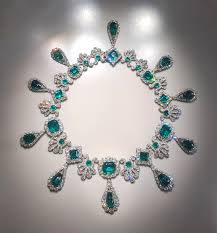
The tiara and brooch owned by Empress Eugénie represented her imperial power and French artistry. In 1853, the gift was ordered by Emperor Napoleon III as a wedding gift to Eugenie. Made by Francois Kramer in 1855, it was composed of 2,634 diamonds and was originally the centrepiece of a belt. The brooch was purchased for the Louvre for €6. 72 million (over $10 million at the time), in 2008, and the tiara in 1992. An emerald necklace and a pair of emerald earrings from Empress Marie Louise symbolized her status as Empress, reflecting Napoleon’s power and wealth. The elaborate design and quality included 32 emeralds and 1,138 diamonds. The set contains high-quality gemstones crafted with exceptional artistry by Jeweller Nitot. A wedding gift from Napoleon to Marie Louise, designed to showcase the wealth and power, holds historical importance. The set was acquired by the Louvre in 2004 for approximately $4 million. “Indicating its substantial worth based on the materials and craftsmanship.” The tiara, necklace and single earring from the sapphire set that belonged to Queen Marie-Amelie and Queen Hortense were symbols of the 19th-century French royalty and French history. The set is priceless, possessing a high monetary value.
The jewelry is indicative of the high quality of Parisian artisans in the early 19th century. The jeweller remains unknown due to the piece’s alterations over time and lack of signature markings. The set includes 24 Ceylon sapphires and 1,083 diamonds in the tiara and eight large sapphires in the necklace. The brooch known as the “reliquary brooch” is/was valued for its historical significance and the precious stones it contained, even though it did not include a relic.
Originally from Empress Eugénie’s collection, this was made in 1855 by jeweller Paul-Alfred Bapst, and was a symbol of her Catholic faith and of the power of the Second Empire. It contains two large diamonds and was originally gifted to King Louis XIV by Cardinal Mazarin in the 17th century. The brooch was acquired by the Louvre Museum in 1887, and has been a part of the museum’s collection until October 19th, 2025, when it was stolen.
In the void where the jewels once glowed, perhaps the surreal crime was never the theft itself, but the presence and absence forcing Paris and an audience to reveal how desire reshapes the line between art and appetite. Confronting cracks that fill in that curiosity running through the veins and bloodstream of every watcher, every masterpiece of art, every thief. Bodybuilding motocross daredevil, Abdoulaye N., 39, nicknamed ‘Doudou Cross Bitume,’ was named a suspect of this captivating heist. He is facing preliminary charges of theft as of October 29, 2025.
The 34-year-old Algerian national, suspected of being one of the two thieves who entered the Apollo Gallery, was arrested at Charles de Gaulle airport as he was about to board a flight to Algeria. With a criminal record for one theft and traffic offences, the man’s DNA was found on a scooter utilized in the getaway. A 39-year-old former delivery driver, also believed to have been one of the two thieves who entered and robbed the museum, was under judicial supervision. A 37-year-old man who was arrested in connection with the robbery, along with the other suspects, or his partners. The man’s DNA was found in the truck driven by the thieves, and he had a record of 11 criminal convictions, together with aggravated theft.
One detail was that this man was arrested with one of the other suspects for a different robbery in 2015. Although prosecutors believe that the traces were “transferred from someone or an object.”
The glass was repaired, the alarms reset, the mystery remained unanswered, but the fracture they carved into the museum’s soul remains glimmering and silent. What lingers isn’t the gemstones taken, nor the minutes in which they disappeared. What was stolen that morning was not merely art, but the illusion that art is ever untouchable.
Some mysteries are not meant to be solved, only endured. The question these men left, unspoken, was ‘who truly owns beauty, the eyes that admire it, or the hands that dare take it?