
The Birmingham Community Charter High School theater department hosted “Antigone,” a play from Greek antiquity. This production ran from March 12 through March 15, 2026, in the Sally Field Performing Arts Center.
The cast members for March 12 and 14 were: Michelle Ayala (11) Messenger, Skye Narag (12) Ismene, William Gorchon (11) Haemon, Ashley Hernandez (11), Antigone, Tristan Trudgeon (12) Creon, Sofia Monroy (11) Euydice, Xitllali Frausto (11) Triresias, Meadow Brown (10), Sentry 1, Audrey Natividad (11) Sentry 2, Abigale Alba (10) Chorus 1, Adrian Angeles (11) Chorus 2, Lindsay Cruz (11) Chorus 3, Nataly Figueroa (11) Chorus 4, Sky Harmony (10) Chorus 5, Damaris Fuentes (12) Chorus 6, Ricardo Oliva (11) Chorus 7/Etocles, David Campos (12) Chorus 8/ Polynices.
The stage managers were: Marley Salinas (11), Jose Camey (12), and Lucy Dixon (11).
On March 13 and 15, the cast members included: Diana Karina (12) Messenger, Chloe Aguilar (11) Ismene, Ashwani Bhardwaj (10) Haemon, Saori Araujo (11) Antigone, Christopher Linares (12) Creon, Melanie Flores (12) Tiresias, Isabella Piscione (11) Sentry 1, and Ashley Flores (11) Sentry 2.
I interviewed two of the cast members from the play, who gave me background on Antigone and how they felt about playing the part. Skye Narag, who played Ismene, Antigone’s younger sister, related to the character in her personal life. “I do have an older brother, so yeah, I do relate to her a little bit, like not wanting to piss off my older brother and just being afraid to, you know, get in trouble.” Tristen Trudgeon, who plays Creon, had a lot of dialogue playing this character. “It was a very interesting experience. I had a lot of say in what went on with the character, so I didn’t feel like I was being bossed around.” Antigone is a play that most cast members have fun with, and they can relate to the characters.
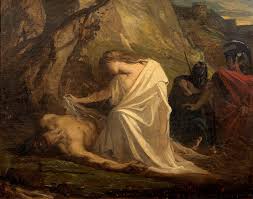
The play was written by Sophocles, the ancient Greek playwright. “Antigone” explores the dangers of excessive pride. It’s based on a Greek tragedy that explores the conflict between divine law and the authority of the state. Antigone and her father have a major disagreement about her brother’s funeral rites, and Creon’s pride gets in the way, which leads to their mutual downfall. This is a very well-known play that has been around for over 2,46o years.
The play begins after the Greek Civil War. Antigone, sister to the fallen brothers, believes that the divine law requires proper burial to enter the underworld. She was caught trying to bury her brother and brought before Creon. She remains defiant that the superiority of “unwritten laws of the gods” rules over human law. Throughout this whole argument, Creon feels that his authority has been challenged, and because of that, he sentences her to be sealed alive in a stone tomb.
A warning from his son, Haemon, and the blind prophet Tiresias, eventually shakes Creon’s resolve. Tiresias warns them that the gods are angry and that Creon will lose his own child as punishment. Antigone has already handed herself into the tomb, Haemon finds her dead body, and kills himself in grief after trying to attack his father. Eurydice, Creon’s wife, then kills herself upon hearing of her son’s death, cursing Creon with her final breath. In the end, Creon was left as a broken man, realizing that his rigid pride had destroyed everything he loved.